


Pro Tips
FSMS meaning: Food Safety Management System explained
FSMS meaning explained: what a Food Safety Management System is, what it includes, and how it helps you stay compliant and inspection-ready.

FSMS meaning: a simple explanation for food businesses
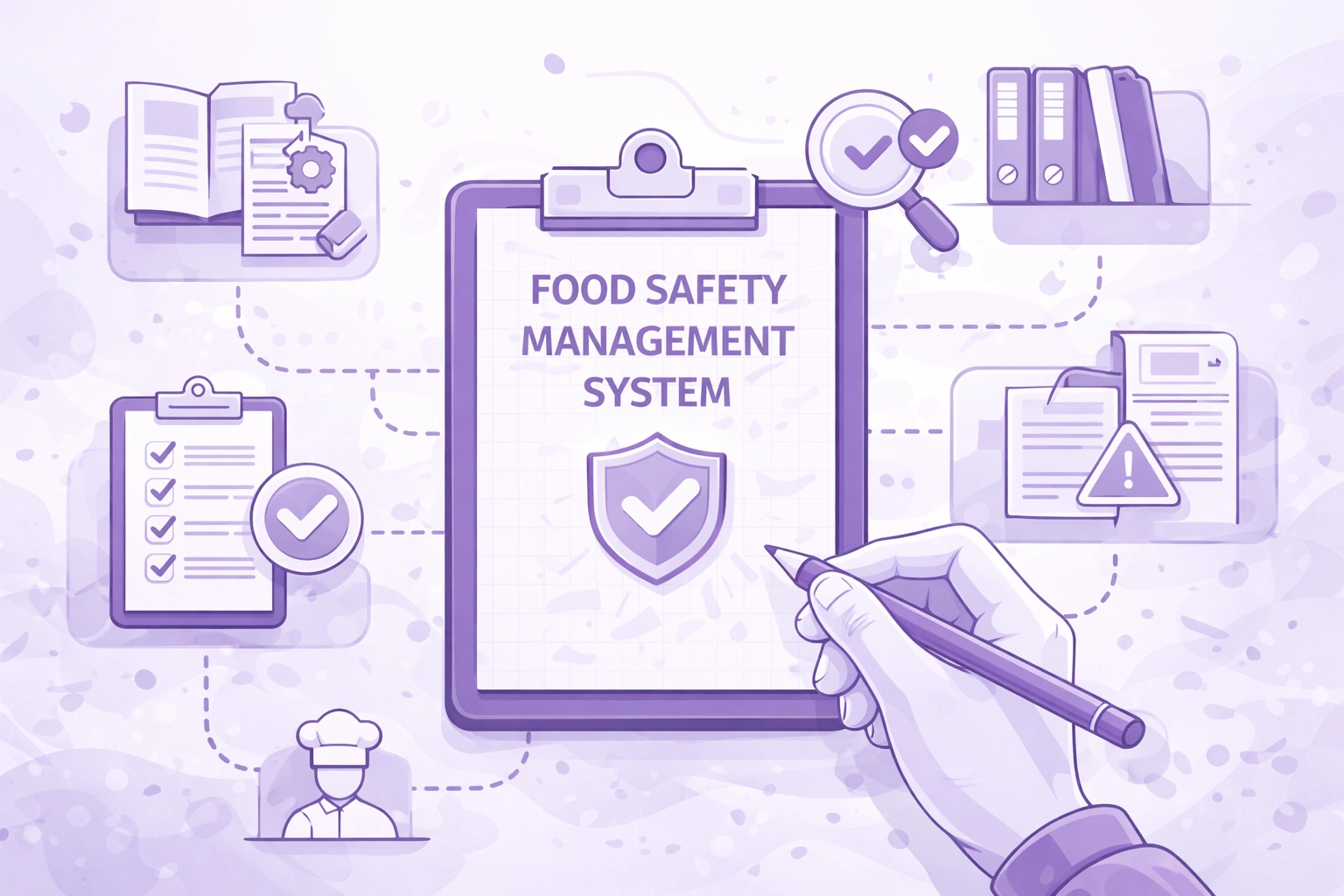
A Food Safety Management System (FSMS) is the way a food business organises food safety routines, responsibilities, and documentation so safe handling happens consistently in real life, not only on paper.
What does FSMS mean in practice?
In practice, FSMS means you have a clear structure for how food safety is managed day to day. It includes the routines people follow, how you train staff, how you monitor key risks, and how you keep records that prove the routines are actually being done.
An FSMS can be digital or paper-based. What matters most is that it is easy enough to use during busy service, and clear enough that anyone on the team can follow it.
Why is an FSMS important?
Food safety is rarely about one single mistake. Most issues happen when small things slip repeatedly, especially when teams are busy, staff changes, or information is scattered across documents, messages, and memory.
A good FSMS helps you:
- Keep standards consistent across shifts
- Reduce the risk of food safety incidents
- Train new staff faster and more reliably
- Stay prepared for inspections because documentation is easy to find and up to date
What should a Food Safety Management System include?
When people say “we have an FSMS”, it can mean very different things. A practical FSMS usually covers five areas:
1) Clear routines that match your operation
Routines should reflect what you actually do, not what sounds good in a template. That is how you get real compliance, not just documents.
2) A way to control the key food safety hazards
This is where many businesses use HACCP-based thinking. You identify what can go wrong, decide where you control it, and make sure those controls are followed.
3) Records that prove the routines are followed
Checks, logs, cleaning records, temperature records, allergen controls, deliveries, maintenance, and corrective actions when something is off.
4) Corrective actions and follow-up
It is not enough to note a deviation. The FSMS should show what you did to fix it, and how you prevent it from happening again.
5) Training and responsibilities
People need to know what to do, why it matters, and who owns each routine.
FSMS vs HACCP: what is the difference?
HACCP is a method for identifying, evaluating, and controlling hazards that matter for food safety. An FSMS is the full management system that makes food safety work in practice.
A simple way to think about it:
- HACCP is the hazard-control logic.
- FSMS is the whole structure around it: routines, training, records, verification, and continuous improvement.
What does an FSMS look like on a busy day?
The biggest difference between an FSMS that works and one that gets ignored is friction. If it takes too long, lives in too many places, or is hard to understand, it will not be used consistently.
A practical FSMS is:
- Simple to complete during service
- Structured so the right checks happen at the right time
- Easy to review weekly or monthly
- Fast to present during an inspection because records are organised and searchable
Summary
FSMS meaning is simple: it is the system you use to run food safety in a structured way, with routines and documentation that actually work in daily operations. A strong FSMS makes compliance easier, training smoother, and inspections less stressful.
For a complete overview and an easy way to keep everything in one place, see our Food Safety Management System page.
Sources
FAO: HACCP System and Guidelines for its Application (Codex)
https://www.fao.org/4/Y1579E/y1579e03.htm
EUR-Lex: Regulation (EC) No 852/2004 on the hygiene of foodstuffs (HACCP-based procedures)
https://eur-lex.europa.eu/LexUriServ/LexUriServ.do?uri=CONSLEG%3A2004R0852%3A20081028%3AEN%3APDF

Related articles

Stay up to date
Industry insights straight to your inbox
Practical insights and smart improvements to simplify hospitality operations. We'll also keep you updated on relevant news from Runwell.